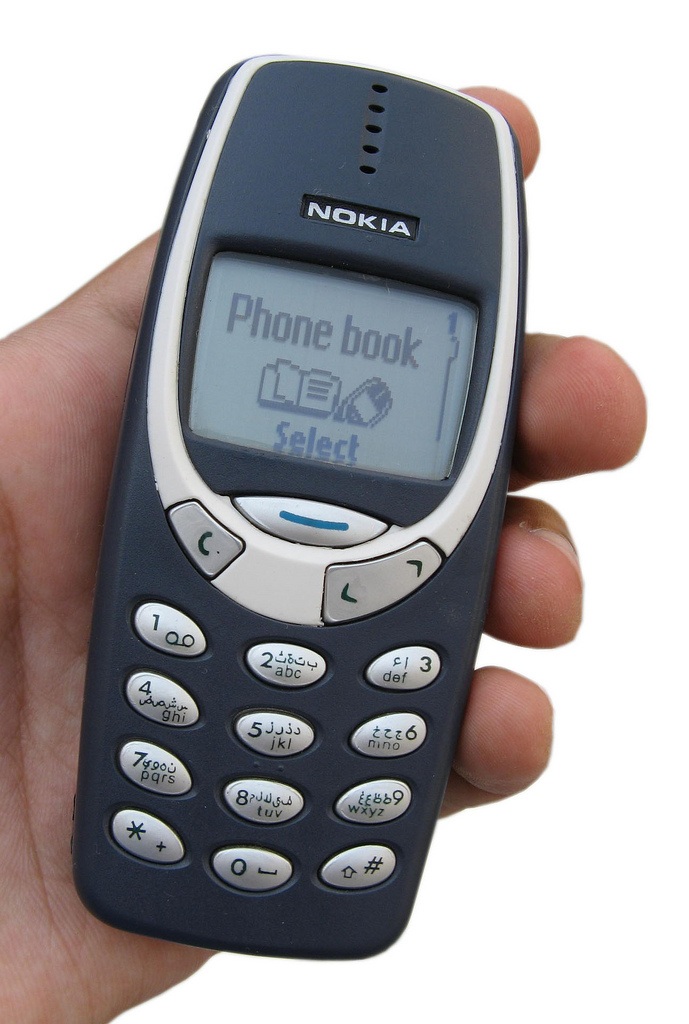
When the Nokia 3310 launched on 1 September 2000, it didn't just sell. It became the definitive object of its era — a phone so robust and so recognisable that it remains a cultural reference point 25 years later. What Nokia's marketing never mentioned was where the phone actually came from: roughly 50 young engineers working out of Nokia's R&D centre at Frederikskaj in Copenhagen's Sydhavn district.
"The design — industrial, electronic, and much of the underlying silicon — was Copenhagen engineering."
The project ran under product manager Lone Tram Middleton. The phone's internal codename was "Beetle." The cheerful, smiling shape of the T9 keypad was deliberate. Production took place in Finland and Hungary, but the design — and the custom chips that made it work — came out of Denmark.

A 60-year lineage — from taxi radios to smartphones
The Nokia Copenhagen story didn't start in 2000. It started in 1951, when a 24-year-old named Anton Petersen founded A.P. Radiotelefoni in Hvidovre — building mobile radios for taxis and mobile telephones for the Norwegian market, at a time when mobile communications was barely an industry.
Anton Petersen founds A.P. Radiotelefoni in Hvidovre — mobile radios for taxis and the Norwegian market.
A.P. launches a 49-channel computer-controlled car radio phone — 170% more channels than any competitor.
Petersen sells to Philips. The Danish engineering team stays intact in Copenhagen through the 1980s.
Nokia acquires Philips' 60-person radio development centre in Copenhagen. Rapid expansion begins.
The site grows from 60 to around 1,500 engineers — becoming Nokia's largest R&D unit outside Finland. The 3310 generation is designed here.
Nokia 3310 launches. 126 million units sold globally.
Nokia closes the Copenhagen site. Around 1,000 engineers at closure disperse into the Danish ecosystem.
What the engineers actually built
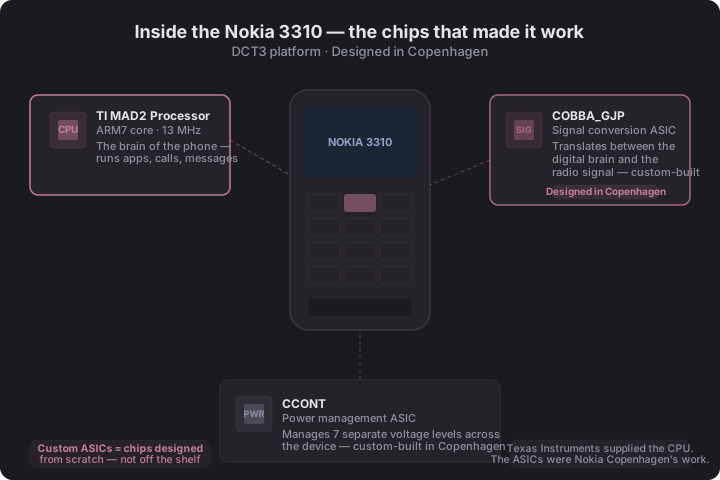
To understand what made the Copenhagen team exceptional, it helps to know what's inside a Nokia 3310. The phone ran on Nokia's DCT3 platform — a tightly integrated system of chips. At its core sat a Texas Instruments processor, but around it were custom Nokia ASICs — specialised chips designed from scratch to handle the conversion between the digital brain and the radio signal, and a dedicated chip managing power across the entire device.
This is called mixed-signal chip design — combining analog and digital electronics on a single piece of silicon, working at the edge of what physics allows. It is among the most demanding engineering disciplines in semiconductors. Copenhagen was Nokia's centre of excellence for exactly this: chip design for the mainstream phone portfolio.
The cluster that survived Nokia
When Nokia closed its Copenhagen site on 31 December 2012, around 1,000 engineers needed new homes. What happened next is the real Danish story: they didn't leave.
The competence Nokia had built over 20 years flowed directly into the companies that define Danish high-tech today. Hearing-aid leaders GN Hearing, Oticon (Demant) and Widex recruited mixed-signal and low-power specialists. IPtronics — a Danish optical-interconnect chip company — absorbed Nokia talent before being acquired by Mellanox in 2013, which was in turn acquired by NVIDIA in 2020. Today, NVIDIA's Denmark R&D team in Roskilde employs over 100 engineers working on next-generation networking silicon — a direct descendant of that Nokia-era expertise. MediaTek and Intel's Danish operations picked up RF and modem designers. Dozens of startups and smaller chip companies absorbed the rest.
The former Nokia building at Frederikskaj now houses Aalborg University's Copenhagen campus — a symbolic passing of the baton from industry to the next generation of students.
Why this matters
The Nokia story is not history. It is a template. It shows that a small country can produce world-class semiconductor engineering — the kind that ends up in 126 million pockets globally — when you invest in the right people and give them a long enough runway.
The competence Nokia built is still here. The engineers moved on to GN Hearing, Demant, NVIDIA Denmark, MediaTek, IPtronics and dozens of other companies — and they kept training new generations. Denmark has one of the densest concentrations of mixed-signal and RF chip expertise in Europe. Not by accident, but because of a 70-year chain of investment in people and knowledge.
Three things this story tells us
- Small countries can produce world-leading silicon — when a company concentrates the right talent and gives it long enough runway.
- Engineering clusters outlive their founding company. The engineers who moved to GN Hearing, Demant, NVIDIA Denmark, MediaTek, IPtronics and dozens of startups — and kept training new generations.
- University pipelines are the load-bearing element. Without DTU's continuous teaching in RF and chip design, none of this chain would exist.
Sources
Da danske mobiltelefoner var verdensklasse — Danmarks Teknologihistorie · Knock it down: det er nok tid for den danske mobilindustri · Aalborg University moves into former Nokia headquarters — Study in Denmark · Nokia 3310 — Wikipedia · Meet the legendary Nokia 3310 designer (Lone Tram Middleton) — EEB · Mobiltelefonen i dansk hans (& dens fremtid) — Anton Petersen · Nokia 3310 Teardown — Lagniappe Portable Computing Wiki
Note: The precise attribution of individual chip blocks to the Copenhagen team vs. Nokia's Finnish sites has not been independently verified and should be confirmed with a primary source before publication.